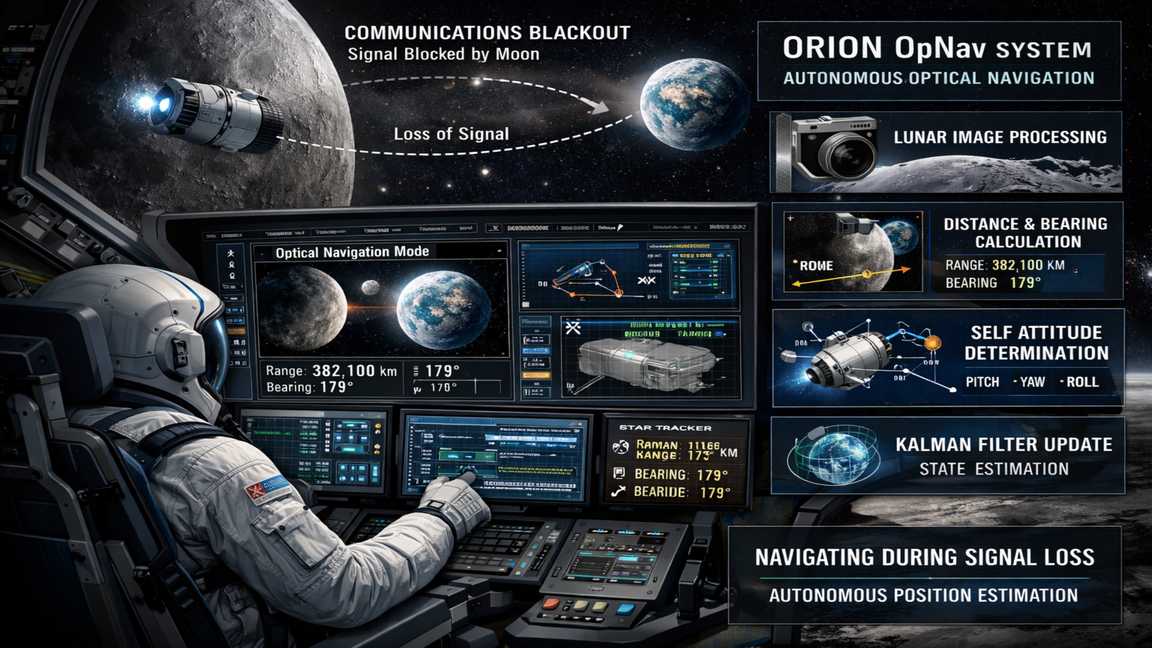
When people think about autonomy in space, they often imagine the far future: distant probes, intelligent robots on alien worlds, or spacecraft making independent decisions millions of miles from Earth. Artemis II offers a more immediate and more revealing example. Even on a crewed mission around the Moon, communication with Earth is not guaranteed at every moment. During its flight, Orion is expected to pass behind the Moon and enter a planned communications blackout lasting roughly 41 minutes, a period when the Moon itself blocks line-of-sight radio contact with Earth.
That detail may sound minor compared with the larger symbolism of returning humans to lunar space. In reality, it points to one of the most important engineering truths in modern spaceflight: a mission does not need to be deep into the outer solar system for communication denial to become operationally significant. Sometimes the challenge is not raw distance. It is geometry, timing, orbital position, and the physical structure of the communication network itself.
That is why Artemis II is so technically interesting. It is not only a Moon mission. It is also a real-world example of how a spacecraft is engineered to remain capable when Earth cannot immediately assist. At the center of that story is Orion’s Optical Navigation system, known as OpNav, a narrowly scoped but deeply important onboard autonomy capability designed to help maintain navigational awareness when ground updates are unavailable.
For me, this is more than an interesting subsystem. My own doctoral research focuses on autonomous multi-agent systems for deep-space scientific discovery under communication denial, where the central question is not simply whether a machine can operate alone, but whether it can continue to operate in a scientifically defensible way when Earth-based oversight is delayed or absent. In that sense, Artemis II represents something larger than a single mission milestone. It shows how real aerospace systems are beginning to confront communication denial not with hype, but with bounded autonomy engineered for resilience.
A Moon Mission With a Real Communications Constraint
NASA’s Artemis II mission will send four astronauts around the Moon aboard Orion. During that mission, Orion is expected to lose contact with Earth for a period of approximately 41 minutes as it moves behind the lunar far side. NASA documentation also notes that the exact duration can vary with mission timing, but the blackout itself is an anticipated and understood part of the profile.
This is an important reminder that communication loss is not reserved for the most distant missions. Even in cislunar space, where a spacecraft is relatively close to Earth on an astronomical scale, line-of-sight obstruction can temporarily cut off direct contact. The result is a mission environment in which onboard systems must preserve safe and reliable operation without assuming that ground control can continuously update state knowledge in real time.
That condition matters especially for crewed flight. If communication is unavailable, the spacecraft still needs to know where it is, how it is oriented, and whether its current trajectory remains valid. This is not a philosophical question about autonomy. It is a concrete systems engineering requirement.
Orion OpNav: Bounded Autonomy, Not AI Theater
In public conversation, the word “AI” often obscures more than it clarifies. Orion’s OpNav system is a good example of why precision matters.
OpNav is not a large language model, not a generative system, and not an “AI copilot” improvising mission behavior. It is better understood as a tightly bounded onboard autonomy capability that uses optical observations to support navigation. NASA’s technical descriptions show that OpNav processes imagery of celestial bodies such as the Earth and Moon, extracts navigational measurements such as range and bearing, and for Artemis II adds self-attitude determination. Those measurements are then fused into Orion’s onboard flight estimation architecture through the spacecraft’s Kalman-filter-based state estimation pipeline.
This is a very different kind of intelligence than what most people picture when they hear the term AI. It is not open-ended, conversational, or unconstrained. It is domain-specific, mathematically grounded, and designed to operate inside strict safety and verification boundaries. In other words, it is exactly the kind of onboard autonomy that aerospace systems can trust.
That distinction is worth emphasizing because it reveals what mission-grade intelligence actually looks like. In real spacecraft, intelligence is often not about imitating human reasoning in a general sense. It is about extracting signal from sensors, managing uncertainty, maintaining state knowledge, and supporting safe operation under degraded conditions.
How OpNav Works in Practice
At a high level, Orion OpNav uses images of the Earth, Moon, and starfields to help determine the spacecraft’s state. The process begins with onboard optical sensing. The system captures imagery and identifies relevant visual targets. From those observations, it computes navigation measurements such as apparent geometry, range, and bearing. For Artemis II, NASA indicates that the system also supports self-attitude determination, strengthening Orion’s ability to maintain local orientation knowledge onboard.
Those measurements do not act in isolation. They are fed into the spacecraft’s estimation architecture, where they are fused over time with other onboard knowledge sources. This is what allows Orion to maintain a coherent state estimate rather than treating each image as a standalone answer. The intelligence is in the combination of perception, measurement extraction, and estimator-driven fusion.
That architecture matters because it reflects a design philosophy that is both conservative and powerful. The autonomy is narrow enough to be testable and certifiable, but useful enough to provide meaningful resilience when communication with Earth is degraded or lost.
NASA’s own research language makes the intent especially clear. In one Orion OpNav paper, the system is described as supporting navigation that can “allow the crew to return safely to Earth in the event of a permanent loss of communications with the ground.” That is a striking statement because it frames OpNav not as a convenience feature, but as part of the safety architecture of human lunar flight.
Why the Blackout Matters Technically
The communications blackout behind the Moon is not just an interesting mission fact. It is a clean example of why onboard autonomy matters even in missions that are still relatively near Earth.
There is a tendency to think of Earth as always available to help, especially for missions in cislunar space. Artemis II shows that this assumption has limits. A spacecraft can be close enough for headlines to describe it as “near Earth” and still face conditions in which Earth cannot provide live support. Once that becomes true, the vehicle must rely more heavily on local sensing and onboard estimation.
That does not mean Orion becomes fully autonomous in a broad, science-fiction sense. NASA’s design remains firmly human-rated and safety-centered. The crew will periodically fly Orion manually during the mission, and the spacecraft’s autonomy exists within a larger architecture of guidance, control, redundancy, and human authority. But that is precisely the point. Artemis II demonstrates that the most valuable autonomy in aerospace is rarely theatrical. It is quietly embedded, highly bounded, and engineered to function during the moments when the system must continue operating without outside assistance.
What NASA Has Done Well
The more closely one looks at Orion OpNav, the clearer it becomes that NASA has approached the problem with strong engineering discipline.
First, the autonomy is narrowly scoped. OpNav owns a specific mission function: optical navigation and state support. It does not attempt to be a general intelligence layer. That makes it far more credible for flight use.
Second, the system is integrated into a broader estimation and control stack rather than treated as an independent decision-maker. It generates measurements, those measurements are fused into the spacecraft state estimate, and the result supports guidance and targeting. That is what good aerospace autonomy looks like: tightly integrated, not loosely imagined.
Third, the design acknowledges degraded communication as a normal operational condition rather than treating it as an extraordinary corner case. This is one of the strongest signals in the Artemis II architecture. NASA is not merely hoping communication remains available. NASA is engineering for the reality that it will not always be.
The Bigger Question Beyond Navigation
As impressive as Orion OpNav is, it also points toward a broader frontier in autonomous space systems.
Navigation autonomy is foundational, but it is only one layer of the larger challenge. Future deep-space missions, especially those oriented around scientific discovery, will need autonomy not only to know where they are, but to decide what matters. They will need systems capable of interpreting anomalies, prioritizing observations, allocating limited resources, updating hypotheses, and preserving coherent mission memory over long periods without human correction.
That is exactly the problem space I am trying to address in my own AMOS research. In my dissertation framing, the question is not merely whether a system can remain operational during communication denial, but whether a complete scientific loop can remain defensible when Earth-based feedback is progressively degraded or permanently removed. The architecture I propose treats that loop as a composition of distinct functions: perception, hypothesis generation, planning, execution, analysis, and memory.
From that perspective, Artemis II solves an earlier but essential layer of the problem. Orion OpNav shows how to preserve bounded navigational intelligence during communication loss. The next research frontier is what happens when the challenge is no longer just maintaining trajectory awareness, but sustaining valid scientific reasoning and action over extended periods without Earth in the loop.
That is where space autonomy becomes truly interesting to me. Not as branding. Not as spectacle. But as a serious systems problem at the boundary of engineering, artificial intelligence, and scientific responsibility.
What Artemis II Reveals About the Future
Artemis II is worth watching for many reasons. It is the first crewed Artemis mission, a major step in returning humans to lunar space, and a high-visibility milestone in NASA’s broader exploration program. But from an engineering perspective, one of its most meaningful lessons is quieter.
It shows that the future of space autonomy will not be built on vague claims about intelligent machines. It will be built on carefully bounded capabilities that preserve mission function when communication is delayed, blocked, or unavailable. It will be built on systems that sense locally, estimate robustly, and operate inside hard constraints. It will be built, in other words, on autonomy that earns trust through design.
That is why Orion OpNav stands out. It is not flashy, but it is exactly the kind of capability that matters. During communications blackout, the spacecraft is not saved by a narrative about AI. It is supported by a disciplined autonomy architecture that can continue turning optical observations into navigational knowledge when Earth cannot help.
For engineers, researchers, and anyone serious about the future of human and robotic exploration, that may be the most important takeaway from Artemis II. The path toward more capable deep-space autonomy will not begin with unconstrained intelligence. It will begin with systems like this one: narrow in scope, rigorous in design, and resilient when the link back home goes dark.
Further Reading
- NASA. (2026, January 29). Artemis II reference guide. https://www.nasa.gov/wp-content/uploads/2026/01/a2-reference-guide-012825.pdf
- NASA. (2026, January 28). Networks keeping NASA’s Artemis II mission connected. https://www.nasa.gov/missions/artemis/networks-keeping-nasas-artemis-ii-mission-connected/
- NASA. (2026). Orion spacecraft. https://www.nasa.gov/humans-in-space/orion-spacecraft/
- D’Souza, C., Holt, G. N., Pointing, C., et al. (2020). Orion optical navigation performance and testing. NASA Technical Reports Server. https://ntrs.nasa.gov/api/citations/20200000664/downloads/20200000664.pdf
- Prokop, L. E., Holt, G. N., Christian, J. A., et al. (2021). Orion optical navigation. NASA Technical Reports Server. https://ntrs.nasa.gov/api/citations/20210000793/downloads/Orion%20Optical%20Navigation.pptx.pdf
- Inman, R. J., et al. (2024). Demonstration of the Orion optical navigation system on Artemis I. NASA Technical Reports Server. https://ntrs.nasa.gov/api/citations/20240011714/downloads/OrionArtemisIOpNav_2024.pdf