An AI Copilot That Finds the Right People and Writes the First Message
A multi-agent LinkedIn networking system that searches for relevant professionals, enriches their context with live data, and generates personalized outreach messages — all in one intelligent, end-to-end workflow.
ROLE
AI Engineer
TYPE
Multi-Agent AI System
STACK
LangGraph · LangChain · OpenAI · Streamlit
CODE
THE PROBLEM
Networking at scale is exhausting — and most outreach sounds like it was written by a bot
Job seekers and professionals building their network face the same grind: hours spent filtering LinkedIn profiles, opening dozens of tabs, crafting individual messages that are personal enough to get a response, and keeping track of who they’ve reached out to. It’s tedious work that doesn’t scale.
Generic outreach templates don’t work — people can spot them instantly. But writing truly personalized messages for every contact takes time most people don’t have. The result? People either burn out or send low-quality messages that get ignored.
Finding the Right People
Manually searching and filtering profiles is slow and inconsistent. You spend more time hunting than connecting.
Writing Personal Messages at Scale
Generic templates get ignored. Personalized messages work — but writing them for every contact doesn’t scale.
No Feedback Loop
Most people have no way to track what’s working in their outreach. There’s no system for learning and improving over time.
THE SOLUTION
AI agents that search, research, and write — so you can focus on connecting
Vyntro is an end-to-end networking copilot. You tell it who you’re looking for, and autonomous AI agents handle the rest: searching for candidates, enriching profiles with live data, scoring relevance, and generating personalized intro messages using your resume and context as a foundation. A feedback loop tracks outcomes so the system improves over time.
01
Autonomous Agent Pipeline
An Orchestrator Agent delegates to specialized Research and Drafting agents — each with their own tools, context, and responsibilities. No manual steps between search and message.
02
RAG-Powered Personalization
Your resume and context are embedded in a vector store. When drafting, the AI retrieves the most relevant parts of your background to personalize each outreach naturally.
03
Ranked Suggestions with Context
Candidates are scored for relevance and presented with skills, LinkedIn URLs, and enriched context — so you know exactly why each person was suggested.
04
Feedback & Analytics Loop
Track which messages get responses, and the system generates insights and recommendations to improve your outreach strategy over time.
HOW IT WORKS
Search, research, draft, and improve — powered by coordinated AI agents
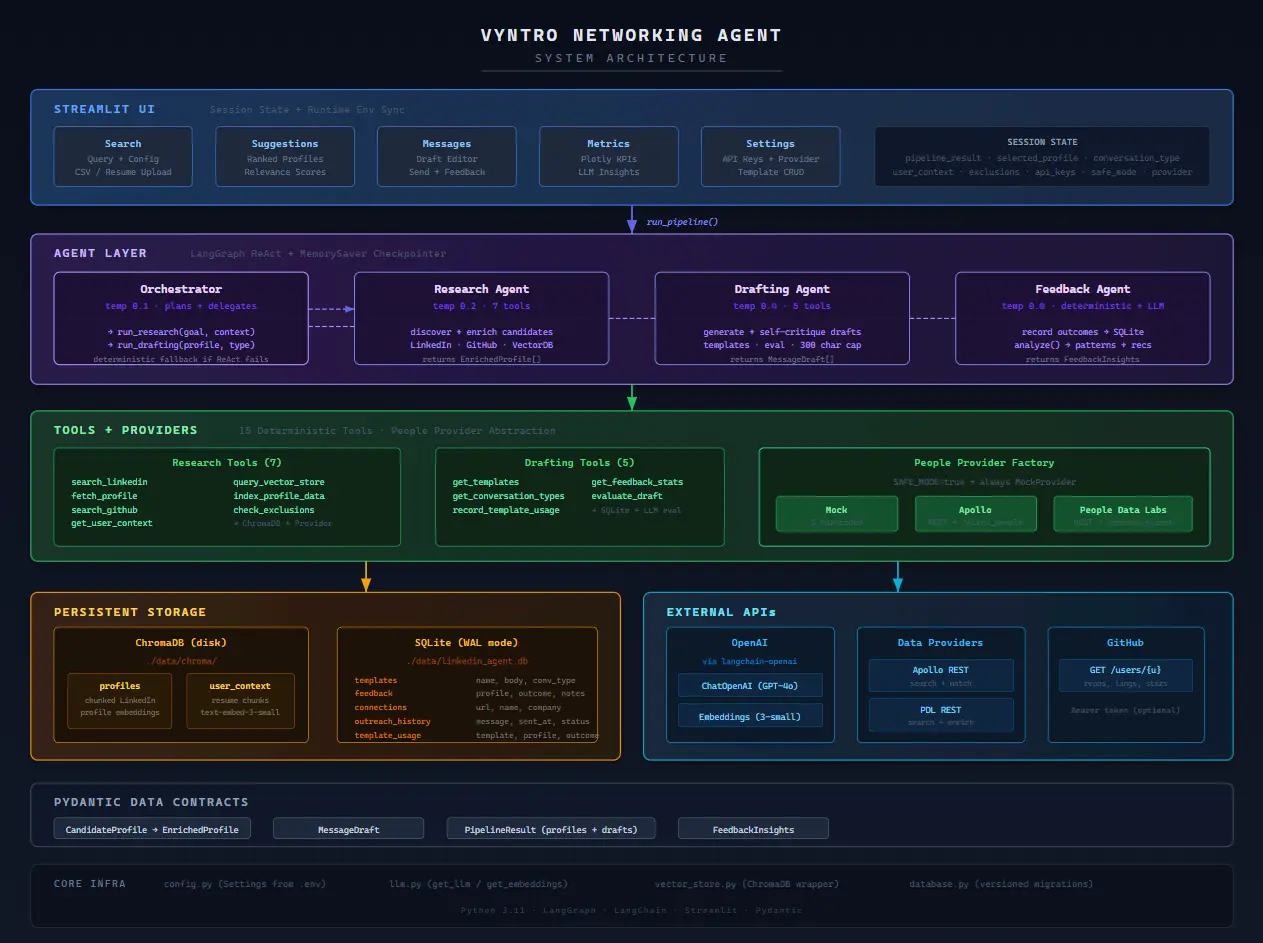
The workflow flows through a multi-agent pipeline: you enter a target role, agents search for candidates and enrich their profiles, a drafting agent generates personalized messages using your RAG-embedded context, and a feedback loop tracks results to improve future outreach.
SEE IT IN ACTION
A complete dashboard from search to outreach to configuration
Vyntro provides a full Streamlit-powered interface where you search for candidates, review ranked suggestions, generate and edit personalized messages, track metrics, and configure API keys and provider settings — all in one place.
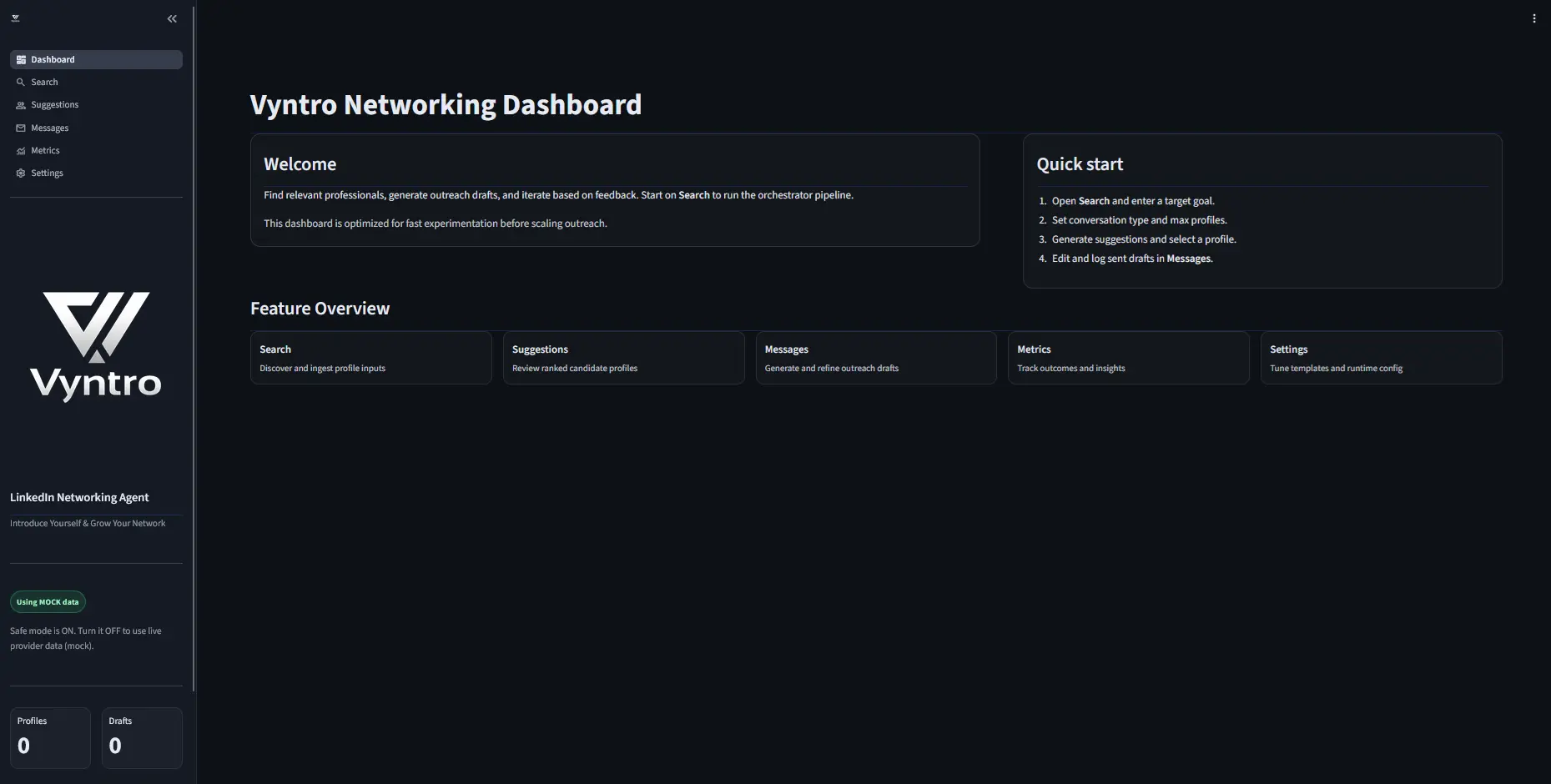
Dashboard
The command center for the full workflow — start searches, inspect suggestions, generate messages, and track outcomes from a single view.
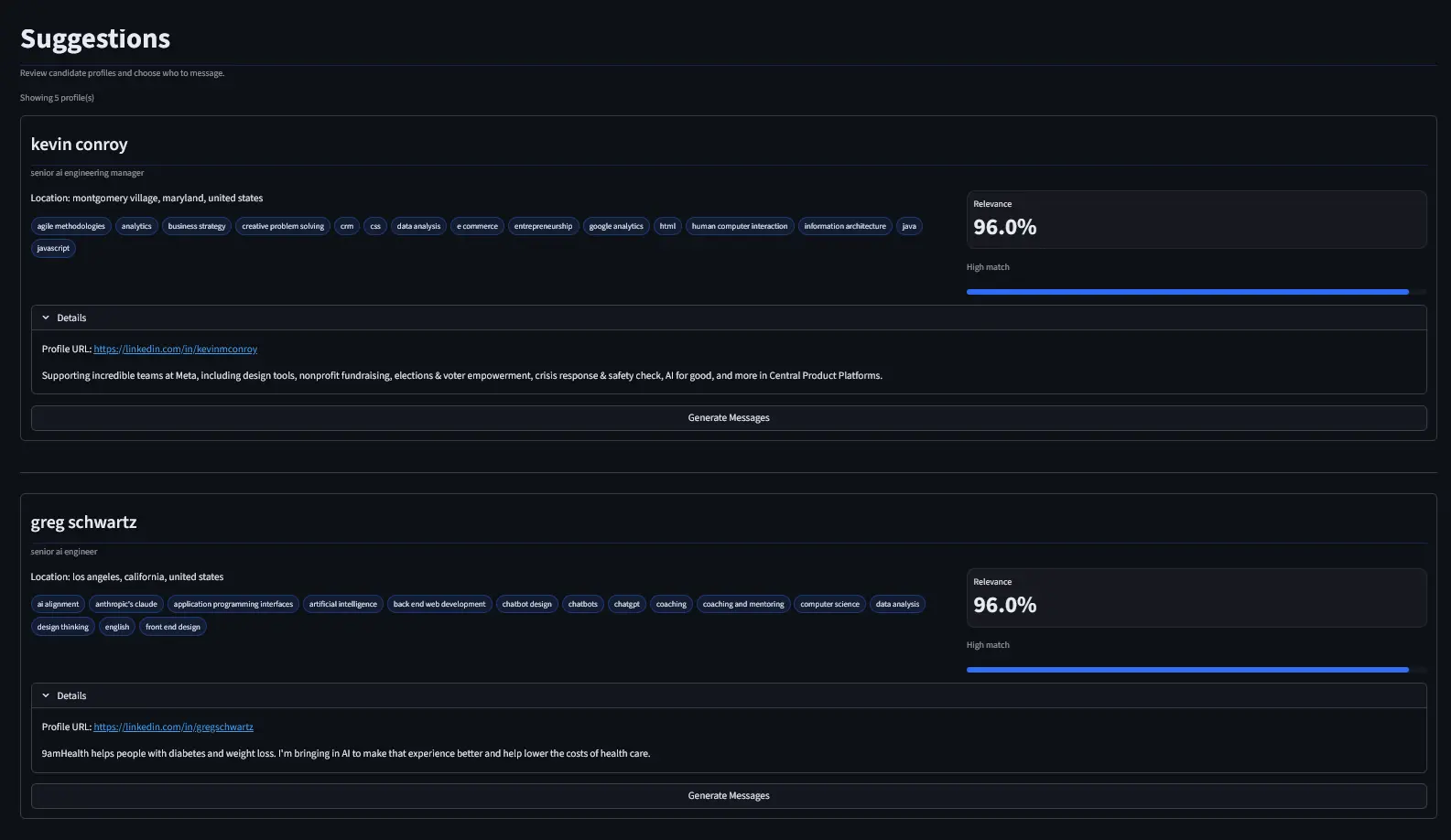
Suggestions & Outreach
Ranked candidates with relevance scores, skills, LinkedIn URLs, and one-click agent-powered message generation for each profile.
ENGINEERING DECISIONS
Why I built it this way
LangGraph orchestration over hardcoded pipelines
Using LangGraph's ReAct-style agent orchestration means the system reasons about what tools to call and when — rather than following a rigid script. The Orchestrator can skip enrichment if data is sufficient, or retry with different tools if a provider fails.
Live provider abstraction with safe-mode fallback
The system supports three data providers (mock, Apollo, People Data Labs) behind a unified interface. Safe mode forces the mock provider, so the full pipeline can be demonstrated and tested without API costs or rate limits.
RAG for personalization, not generation
The vector store doesn't generate content from scratch — it retrieves the most relevant parts of your resume and context to inform the drafting agent. This keeps messages grounded in your actual background rather than generic AI filler.
Pydantic contracts at every boundary
Every handoff between agents, tools, and the UI is typed with Pydantic models. This eliminates an entire class of runtime bugs — if the data shape is wrong, it fails fast with a clear error instead of producing garbage downstream.
BY THE NUMBERS
Impact at a glance
4
Specialized AI agents coordinated by an autonomous orchestrator
3
Data provider modes with safe-mode fallback for demo & testing
3
Architectural layers from UI to storage with typed contracts throughout
TECH STACK
Built with
REFLECTIONS
What I learned building this
Agentic systems need escape hatches
Autonomous agents are powerful, but they also fail in unexpected ways. Building deterministic fallback logic into the tool layer — so the system degrades gracefully rather than crashing — was one of the most important design decisions.
Provider abstraction pays for itself immediately
Supporting mock, Apollo, and People Data Labs behind one interface meant I could develop and demo the full pipeline without burning API credits, then switch to live providers with a single config change.
Typed contracts prevent an entire class of bugs
Pydantic models at every agent-to-agent and agent-to-tool boundary caught data shape issues at the earliest possible moment. In a multi-agent system where data flows through many components, this discipline is essential.
Solving your own problem produces better engineering
I built Vyntro because I experienced the networking pain firsthand during my own job search. That personal frustration drove better product decisions — every feature exists because I actually needed it.
EXPLORE
Want to see the code?
The full source code, architecture documentation, and sample reports are available on GitHub.