Turning Messy Patient Charts Into Clear, Trustworthy Summaries
An AI system that reads through an entire patient medical record — labs, medications, notes, vitals — and produces a clinician-ready summary that flags risks, spots gaps, and cites every claim.
Patient charts are a mess — and lives depend on reading them correctly
A single patient’s medical record can contain hundreds of entries across lab results, medication lists, clinical notes, and vital signs — often spread across years and written by different providers. Clinicians, care managers, and reviewers spend enormous time manually piecing these together, often under pressure.
Critical information gets buried. Contradictions go unnoticed. Risk signals are missed.
📋
Information Overload
Hundreds of entries per patient — labs, meds, notes, vitals — with no unified view.
⚠️
Hidden Contradictions
Different parts of the chart may disagree with each other, and nobody catches it.
⏱️
Clinician Burnout
Manual chart review is tedious, time-consuming, and a major contributor to burnout.
THE SOLUTION
An AI system that reads the chart, flags what matters, and shows its work
I built a multi-agent system that takes a raw patient record and produces a complete, clinician-style analysis — summarizing what’s important, flagging risks, identifying gaps, and citing every single claim back to the original data.
01
Patient Snapshot
A clear overview of demographics, active problems, medications, and key lab/vital values — everything a clinician needs at a glance.
02
Risk Flags
Automatic detection of concerning patterns like abnormal lab trends, elevated blood pressure, or prediabetes-range values — each with a plain-language explanation.
03
Missing Info & Contradictions
The system spots what’s missing or inconsistent — documentation gaps, conflicting entries, and unresolved references across the chart.
04
Full Citations
Every claim in the output links back to its original source record. Nothing is invented. Everything is traceable and auditable.
HOW IT WORKS
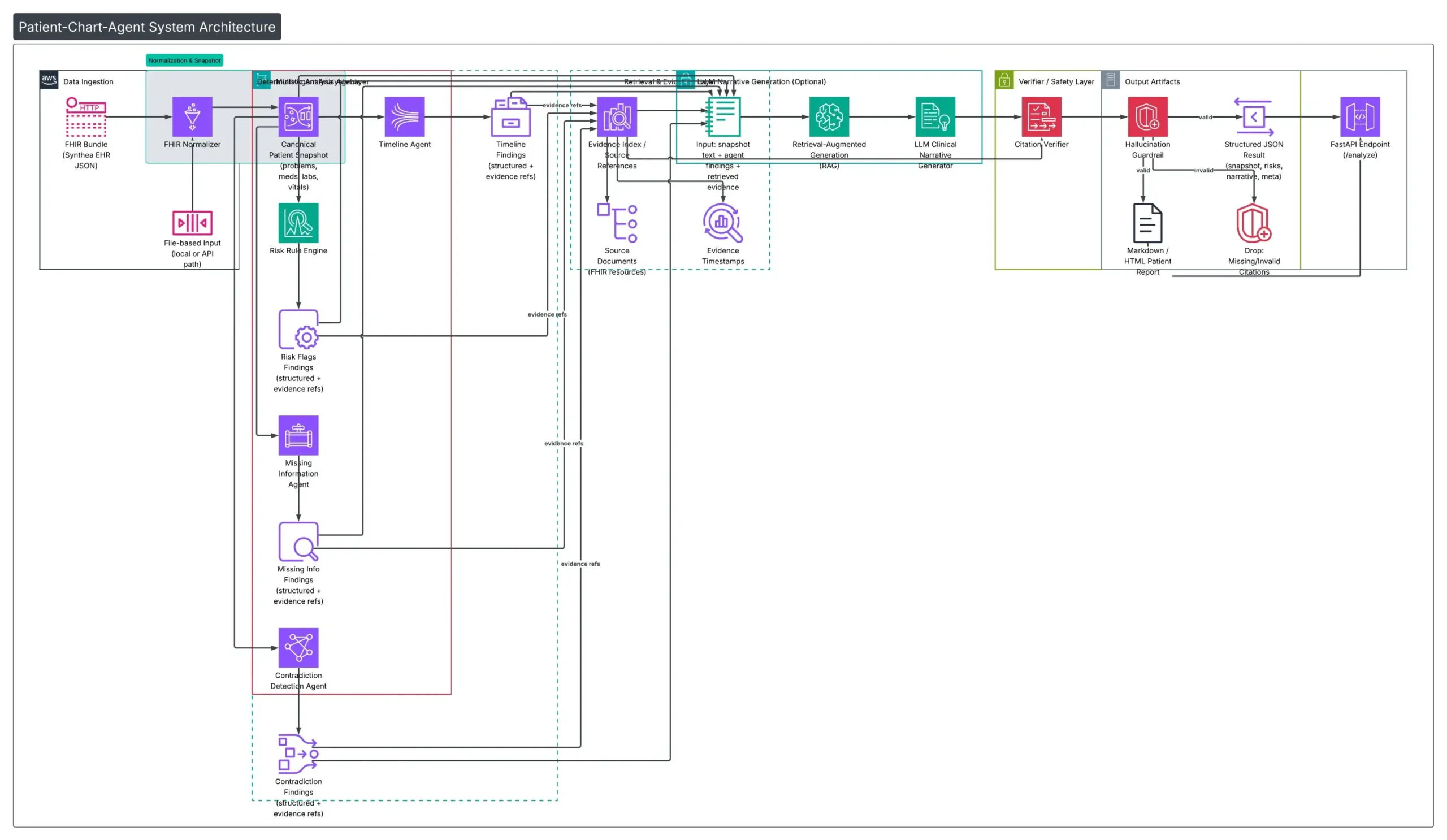
Six specialized agents, each with one job
Rather than one monolithic AI, the system uses a team of focused agents — each responsible for a specific task. This makes the system explainable, testable, and safe.
Step 1
Read & Organize
→
Step 2
Build Snapshot
→
Step 3
Flag Risks
→
Step 4
Find Gaps
→
Step 5
Verify Claims
→
Step 6
Write Summary
SEE IT IN ACTION
From raw patient data to clear, cited analysis
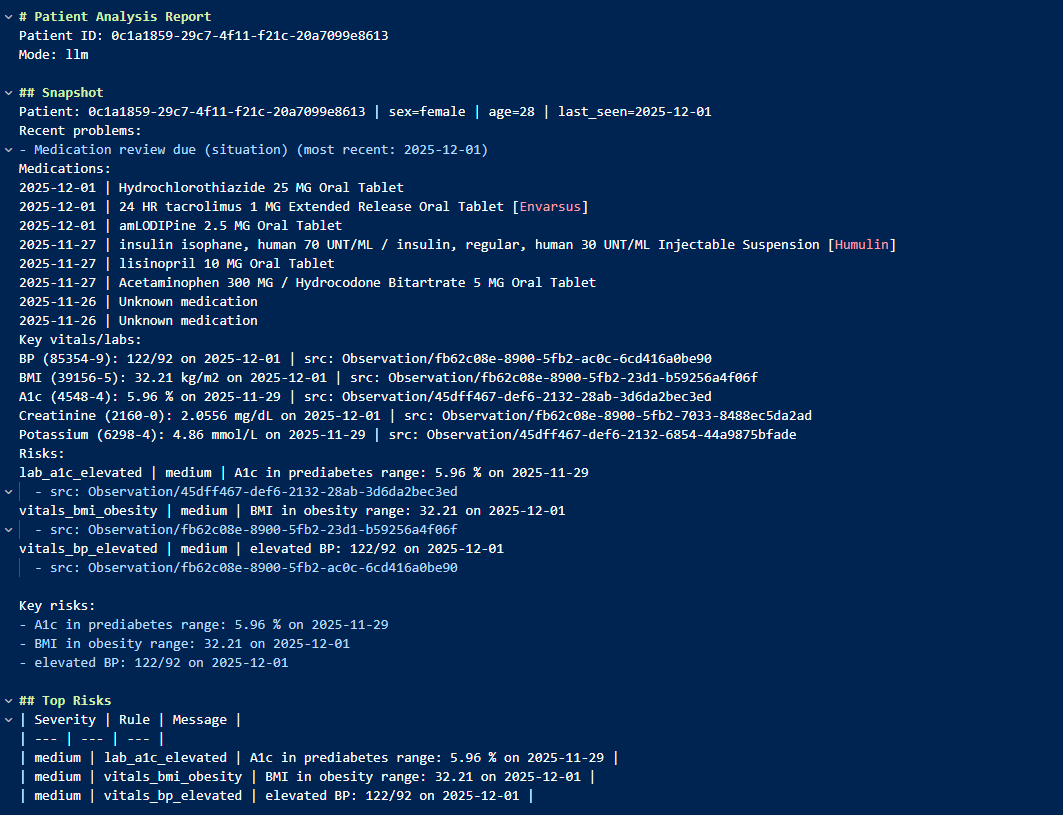
Here’s an example: a synthetic patient record is fed into the system. Seconds later, the output is a structured report that any clinician could immediately use.
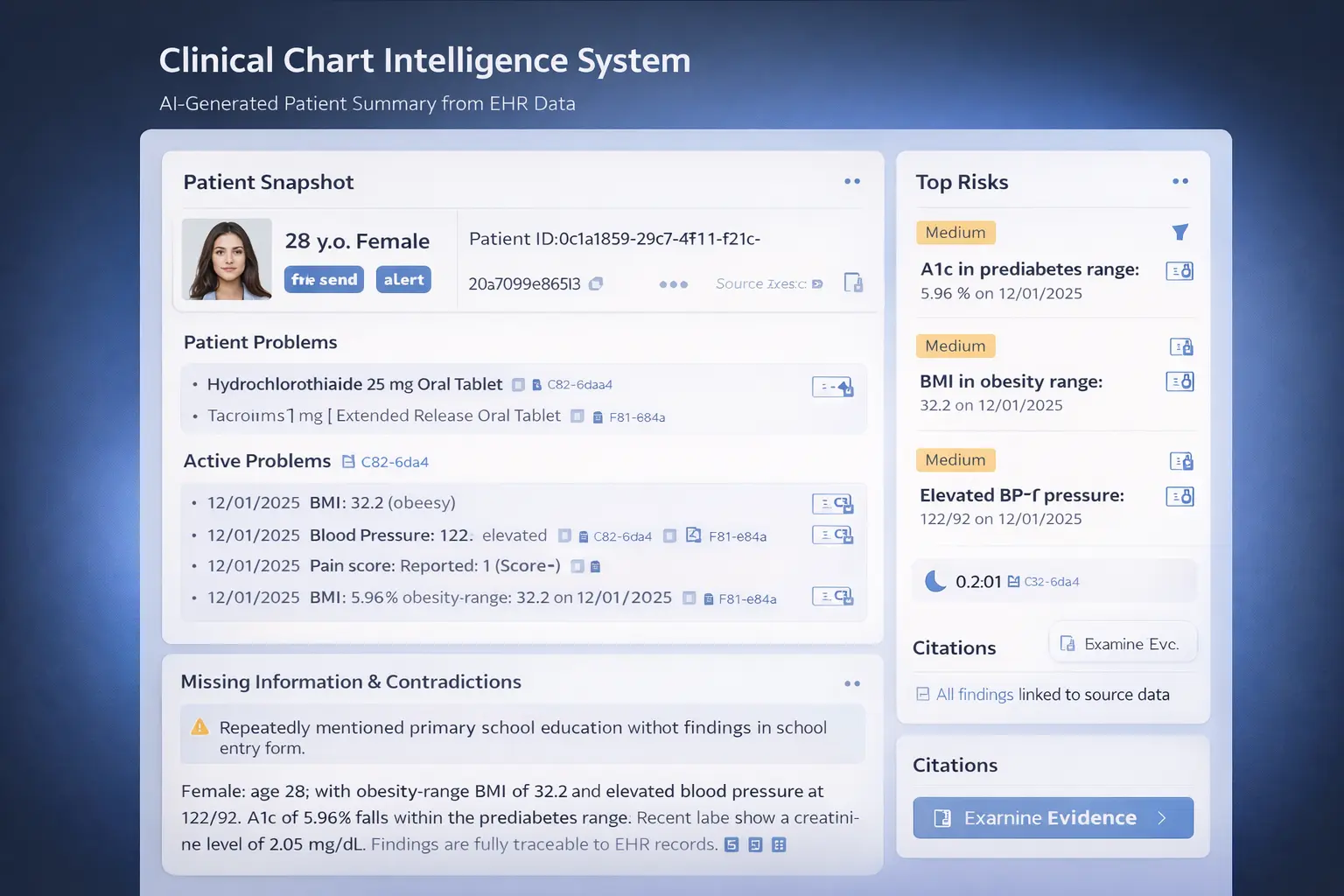
Patient Summary & Risk Flags
The system identifies obesity-range BMI, elevated blood pressure, and prediabetes-range A1c — all with severity levels and source citations.
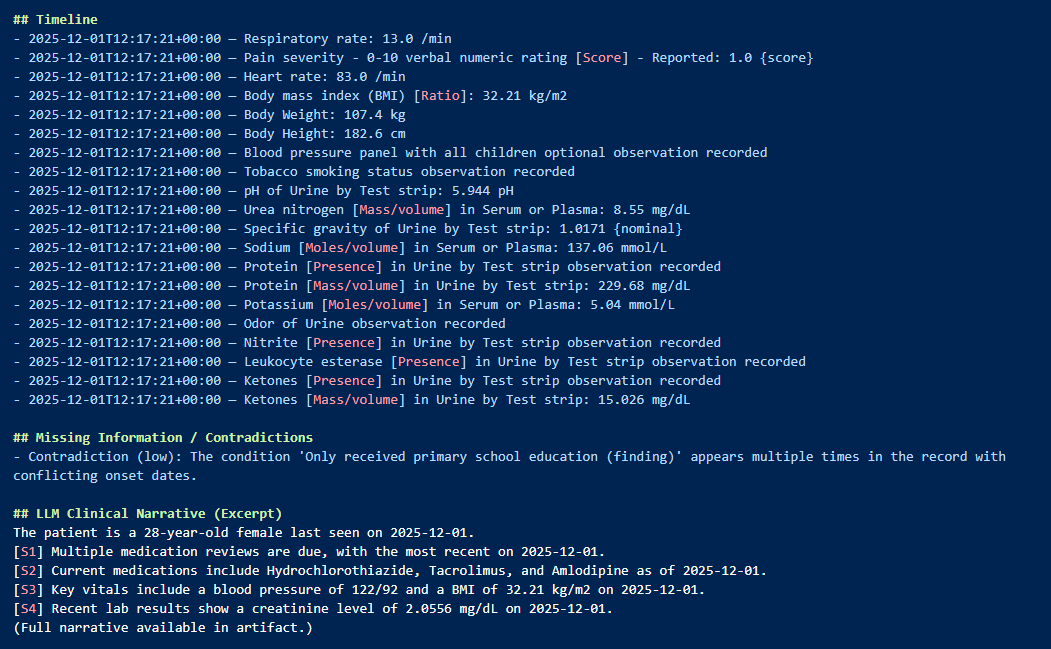
Evidence Trail & Narrative
Every finding links back to its FHIR source record. The clinician-style narrative is generated only from verified data — nothing is invented.
ENGINEERING DECISIONS
Why I built it this way
1
Multi-agent over monolithic
Instead of one big AI prompt, each agent has a single responsibility. This makes the system testable, debuggable, and auditable — critical in healthcare where you need to explain every output.
2
Deterministic first, LLM optional
The core analysis runs without any AI model. The LLM layer only adds a narrative summary — and only from verified data. If the AI fails, the system still works.
3
Citation-first output discipline
Every claim must link to a source record. If a statement can't be cited, it gets removed. This is the design principle that makes the system safe for clinical use.
4
Synthetic data from day one
All development uses Synthea-generated patient data, eliminating any privacy concerns while still providing realistic clinical complexity.
BY THE NUMBERS
Impact at a glance
6
Specialized AI agents working as a coordinated team
100
Synthetic patient records analyzed with full traceability
100%
Citation coverage — every claim links to source evidence
In healthcare AI, “fail safely” isn’t a feature — it’s the architecture. Every design choice was filtered through: “What happens when this goes wrong?”
Deterministic + AI is more powerful than AI alone
The hybrid approach — rule-based analysis as the foundation, LLM as an optional narrator — produces more reliable and trustworthy output than pure AI generation.
Agent boundaries are design decisions
Deciding what each agent should and shouldn’t do was the hardest part. Getting the boundaries right made everything downstream — testing, debugging, auditing — dramatically easier.
Healthcare data standards are complex but essential
Working with FHIR/HL7 standards taught me that the hardest part of clinical AI isn’t the AI — it’s understanding and correctly handling the data.
EXPLORE
Want to see the code?
The full source code, architecture documentation, and sample reports are available on GitHub.