AI-assisted coding tools powered by large language models are rapidly changing how software is built. Practices like vibe coding, where developers describe intent in natural language, and AI synthesizes working code, offer dramatic productivity gains and shift the developer’s role from typing code to directing it.
But this shift introduces governance, security, and operational risks that traditional SDLC practices were never designed to handle. What looks like a developer productivity story is quickly becoming a governance and compliance story at enterprise scale.
The Event Horizon in Software Engineering
Tools like GitHub Copilot, Cursor, and Claude Code allow developers to generate entire features conversationally. In many cases, code is accepted, tested, and shipped without being deeply inspected.
This creates an event horizon for software engineering. Long-standing assumptions about code ownership, traceability, review discipline, and compliance visibility begin to break down when large portions of a system are produced by probabilistic models rather than deliberate human construction.
The Technical and Security Risks
AI-generated code often appears clean and functional while hiding subtle risks. Security studies and industry reports show recurring issues such as injection flaws, unsafe dependency usage, and hardcoded secrets appearing in AI output.
Common patterns include:
- Invented or unsafe dependencies that introduce supply chain exposure
- Code that is logically correct but insecure under adversarial input
- Massive AI-generated commits that bypass incremental review practices
AI output must be treated as untrusted until verified. At scale, this is a new discipline many teams have not yet adopted.
Where Governance Starts to Break
AI-assisted coding erodes the clarity of responsibility that enterprise governance relies on.
In traditional development, an organization can explain who wrote the code, who reviewed it, and how it evolved. When code is produced through prompts and conversational iteration, that clarity fades.
Organizations are left without clear answers to questions like:
- Who owns AI-generated code?
- How does licensing apply to outputs influenced by unknown training data?
- Who is accountable when AI-generated logic is involved in an incident or audit?
These are not theoretical concerns. They are the questions raised during audits, legal discovery, and post-incident reviews. Most teams today do not have documented answers.
The Rise of Shadow AI
At the same time, developers are quietly integrating AI tools into daily workflows without formal approval or oversight. Prompts may include internal schemas, API logic, or sensitive system details.
This creates untracked data exposure, potential regulatory violations, and tool usage that legal and compliance teams have never evaluated. In many organizations, AI-assisted coding is already widespread while governance teams remain unaware.
Why This Becomes a Legal and Audit Problem
Audits require proof of code provenance, secure development practices, and clear ownership of system behavior. AI-generated code complicates each of these requirements.
Without traceability of prompts, model versions, and outputs, organizations lose the ability to explain how critical software artifacts were produced. At that point, the issue is no longer technical. It becomes legal, regulatory, and reputational.
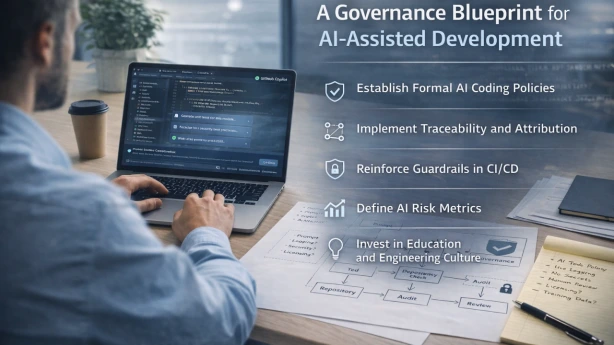
A Practical Governance Blueprint
AI coding is not a tooling problem. It is a governance problem.
Organizations need:
- Clear policies defining approved AI tools and usage boundaries
- Traceability of AI prompts and outputs tied to commits
- Stronger CI/CD guardrails tuned to detect AI-specific patterns
- Risk metrics that track issues tied specifically to AI-generated code
- Developer education that reinforces verification over blind trust
Governance must also align with emerging frameworks such as the NIST AI Risk Management Framework and the EU AI Act, because this is no longer purely an engineering concern. It is a policy concern.
What Organizations Must Do Next
AI-assisted coding represents the most significant shift in software development since the IDE. Without deliberate governance, the productivity gains risk being offset by security debt, compliance exposure, and architectural fragility.
This is an inflection point. Organizations must embed AI into their engineering culture with the same seriousness they apply to security and compliance, because intent is becoming cheap, but verification is becoming critical.
Further Reading
- IAPP — Vibe coding: Don’t kill the vibe, govern it
- GitHub — AI policy and governance for developers
- NIST — AI Risk Management Framework
- Apiiro — Security risks in AI-generated code